
- 12
- Jan
Shebag’s 2026 Celine Collection Has Arrived (Jan 2026 updated)
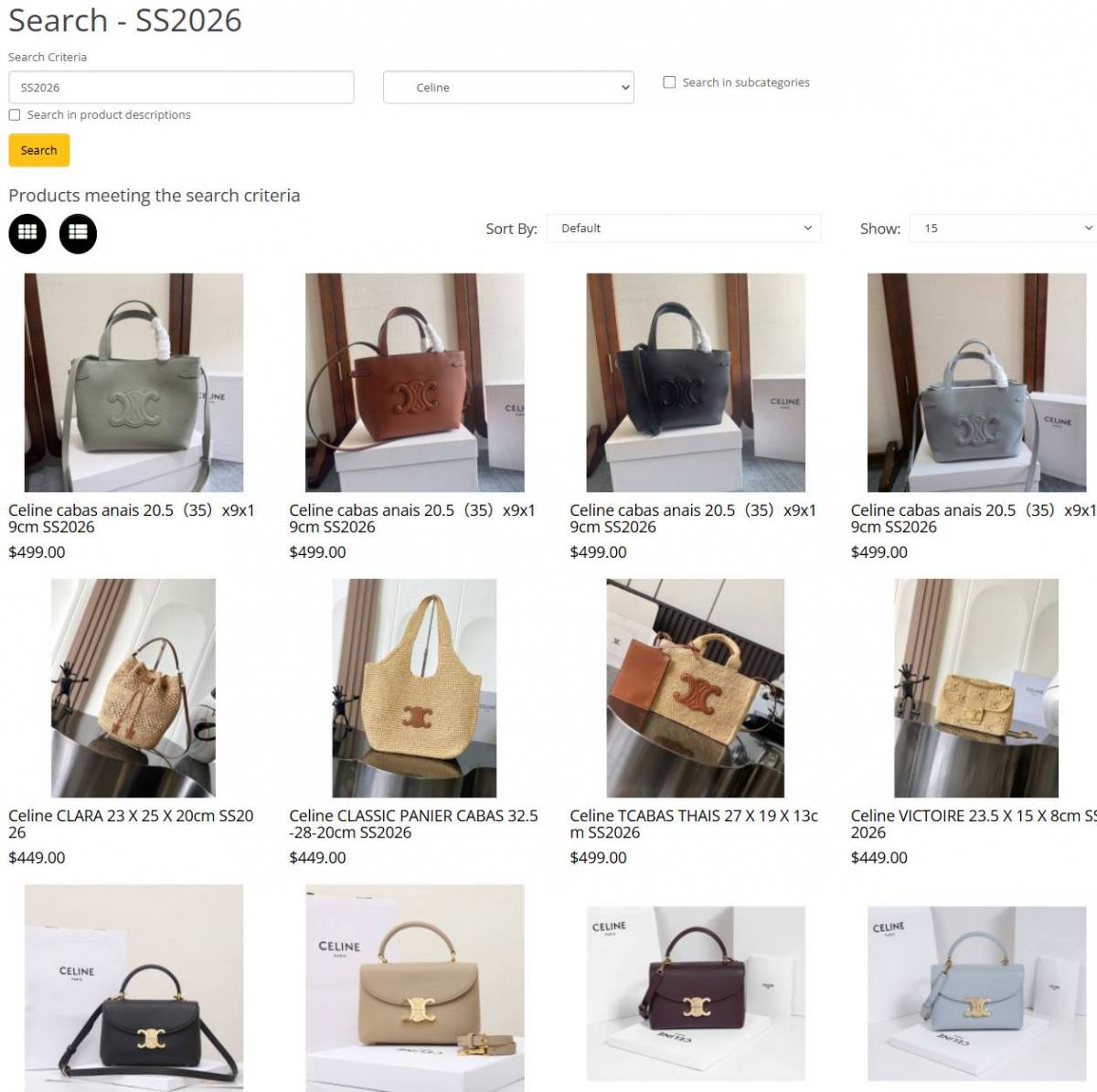
The Shebag workshop is currently in production for the 2026 new bag models, alongside updated 2026 versions of many classic styles. The Triomphe remains the definitive classic, followed by the recently surging Raffia/Basket bags. Celine has always maintained an exceptionally high positioning, aspiring to rival Chanel. Consequently, their leather materials are premium, keeping the cost of replication high.
Today, Shebag is sharing insights into Celine’s leather supply chain, where quality requirements rival those of Chanel.
1. The Supply Chain: Who Actually Supplies Celine?
There are actually very few French or Italian leather factories that can be “named” and explicitly linked to Céline. The list of Tier-1 tanneries for luxury brands is usually confidential (especially for long-term bulk supply).
Below are two tanneries with strong public evidence of their connection, along with a candidate pool within the LVMH system.
France:
- Les Tanneries Roux (Romans-sur-Isère, France): Public records indicate this tannery has long supplied multiple luxury brands and explicitly lists Céline as a partner/client. Furthermore, this factory has been acquired by LVMH, a typical move by the group to tighten control over core leather supply chains.
Italy:
- Conceria Nuova Overlord (Santa Croce sull’Arno, Tuscany, Italy): In industry media and interviews, this tannery has mentioned Céline among its client brands (alongside other top-tier names). It is one of the rare cases of an Italian tannery publicly mentioning a brand client.
LVMH Candidate Pool (For Further Verification):
- LVMH Métiers d’Art: The group’s material/craftsmanship division publicly mentions key tannery assets including Masoni and Roux, as well as Heng Long and Verdeveleno for exotic leathers. These resources are deployed by the group to serve its various Maisons.
2. Céline’s Quality Philosophy: Result-Oriented Engineering
Céline’s control over leather supply chain quality is essentially a system of “Result Orientation + Engineering Logic,” rather than the “Leather-Centrism” emphasized by traditional luxury.
- Integrated Evaluation: In Céline’s system, leather is never judged in isolation. Its quality is forever bound to “the state of the bag after years of use.” Internal quality assessment doesn’t ask “Is this hide good?” but rather “Will this hide, in this bag model, collapse, deform, or suffer stress mismatch with the lining after ten years?” Therefore, QC is a comprehensive evaluation involving leather, structure, lining, gluing, fold angles, and stitch tension simultaneously.
- Physical Stability: Céline’s core requirement isn’t scarcity or visual shock, but physical stability. Specifically, they demand extremely tight tolerances for thickness, elongation rates, rebound performance, and deformation control under heat and humidity. Many leathers used by Céline are not “standard stock” from tanneries but are tanned with custom parameters for specific bag models (e.g., locking in target stiffness and fold-memory during the tanning stage). This makes Céline’s leather not necessarily “visually stunning” as a raw hide, but structurally extremely stable once assembled.
- The Leather Lining System: A crucial point is Céline’s extensive use of leather linings rather than fabric or microfiber. This is a structural choice, not just a decorative one. The lining must match the outer leather in elongation, shrinkage, and aging rhythm. Otherwise, long-term use leads to stress disparity between layers, causing delamination or deformation. Céline treats the outer skin and lining as two parts of the “same engineering system.”
- Industrial Precision: For batch management, Céline is paranoid about consistency. They would rather sacrifice yield and scrap qualified hides than accept obvious leather grain differences across seasons for the same bag. This makes their supply chain look more like industrial-grade precision manufacturing than traditional handmade luxury.
3. Comparison: How does it differ from Chanel and Hermès?
Chanel: Standardized System Control Chanel’s logic is completely different. Its core is “Standardized System Control.”
- Quality depends on satisfying a series of quantifiable metrics (thickness range, abrasion resistance, color fastness, fatigue tests). The goal isn’t to make one bag the best, but to ensure replicability across global workshops.
- Leather serves scalability. As long as it meets the standard, it is qualified; individual character is not emphasized.
- This explains why Chanel accepts fabric or Alcantara linings—they are mature, stable, cost-efficient solutions, not quality compromises. Chanel seeks controllability and consistency over time, not natural evolutionary beauty.
Hermès: Leather-Centrism Hermès operates on a philosophy of “Leather-Centrism” that exists almost independently of modern industrial systems.
- Quality control starts from the leather itself, not the bag model. Each hide is an individual entity; its origin, flaws, grain flow, and flexibility are assessed individually. The bag model is chosen based on the state of the leather.
- Upstream control is deep (from the ranch level). Inside the workshop, artisans have veto power to reject a hide without needing a quantified reason.
- The result is an extremely high “upper limit” for individual hides, but batch consistency is not the priority. Differences between years and artisans are the “sense of life” that Hermès cherishes.
Differing Values
The fundamental difference lies not in who is stricter, but in the values they guard:
- Céline guards the structural state and rational beauty of the bag over long-term use. It is a calm, engineered, and extremely restrained quality logic.
- Chanel guards stable output and brand identity consistency on a global scale. It is a highly industrialized luxury quality management system.
- Hermès guards the value of life and irreplicability of the leather itself. It is a handmade civilization centered on the material.
Therefore, when comparing the physical items: After ten years, a Céline bag typically “retains its shape and feel”; a Chanel bag remains “consistently usable”; and an Hermès bag sees its “leather gain more character.” These are not differences in superiority, but the inevitable results of three completely different quality philosophies.